Tuesday, July 14, 2020
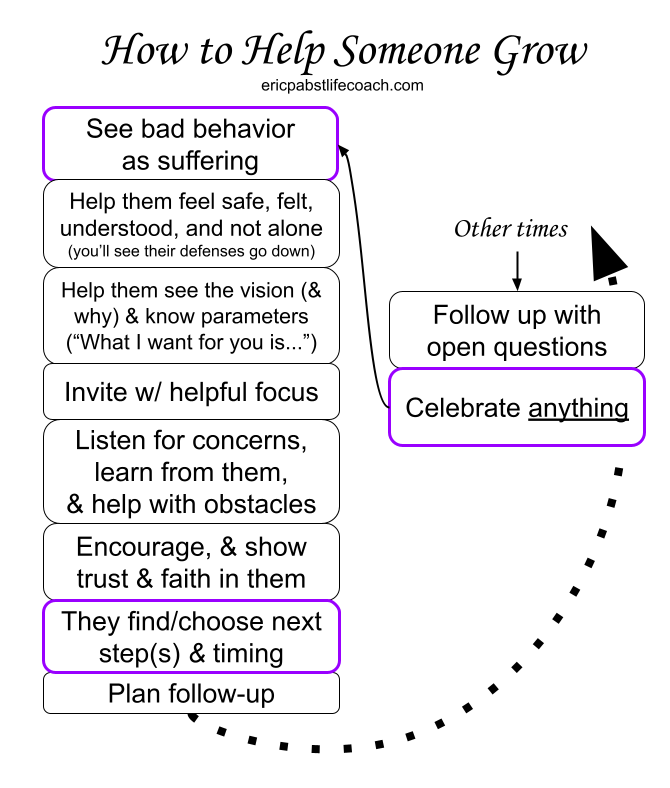
How to Help Someone Progress
The title "Hold Accountable in the Lord's Way" could be ignored or adjusted in many ways. This is what I've learned as an effective way to help someone progress.


Saturday, June 20, 2020
Needs
Do you ever feel like your needs are not being met? Do you ever feel neglected by others? How many of us are suffering from unmet needs? What are needs? How can we know what our needs even are?
Who is responsible for meeting our needs? What role do we play in our own needs? What role does God play in our needs? Have we ever had our needs not be met and then later realize that we still ended up ok anyway? Have we ever gotten very upset, made a fuss, suffered. cried and even grieved over our unmet needs until we eventually accept our reality and make peace with it? What happened in those situations? Did our needs change or did our belief about our needs change? Isn't it God's responsibility for our needs to be met? Doesn't he give us air to breathe, water to drink, food to eat, shelter, and clothing one way or another? Doesn't he put people in our path and into our lives to make sure that we are eventually alright? Don't we even need times of struggle to learn and grow? Don't we all have a time eventually when it is our time to die and we won't even need our "basic needs"?
If God is faithful, is there ever really a moment that our needs are not met? Really think about it. Is there? I believe there isn't. Our actual honest to goodness needs are always met. So... what does it mean when we feel our needs are not met? Doesn't it mean we don't understand our needs as well as God does? We can argue, complain, become bitter, pity ourselves, blame others, and suffer in any number of ways, but the fact remains that our needs have actually been met the whole time.
I'm not saying that we need everything that happens to happen, but I am saying that we didn't need it to not happen. I'm also not saying that our desires aren't very important and valid. They are worth seeking fervently, especially with God's blessing and help. It is also our privilege and calling to help bless others in their needs and desires.
The real issue is: do each of us want to suffer and be in agony or do we want to trust God's wisdom and be truly happy? It's totally ok to make either choice. We all choose to suffer sometimes. I just think it may be helpful to be aware of and remember that we have that choice. God will always and has always provided for all of our needs. He is so incredibly great. Blessed be the name of our God.
Saturday, May 2, 2020
How to not shoot down others' ideas and still get what you want
I have a tendency to shoot down other people's ideas. I often come up with ideas that I think are totally awesome and, in my mind, fit the problem really well. However, to my chagrin, when I share ideas I have sometimes done it in a way that is confrontational or even combative. People sometimes resist them, get upset, or are frustrated that I am shooting down their ideas. I then judge them for being self-absorbed, having their own agenda, not wanting the overall good, or being closed-minded (which ironically is probably more true about me). This then spirals down to either arguing or putting up walls with subsequent grumblings.
Recently when someone brought up a concern about me shooting down their idea, I stepped back to really look at the situation. I have started to see beyond people's words, tone, and expectations and to get a deeper sense of their feelings and desires. In doing so, I really don't want to hurt people, and shooting down their ideas does hurt them, hurts our relationship, is demeaning, and chases away creative juices. After pondering it and using some of the principles I'm learning right now about how to regard people, an approach came to mind.
Think of an "idea" as an option for solving a problem. There are often several options for the exact same problem. However, the options are not equal. Each option has pros and cons which can be represented as requirements and preferences. A "requirement" is something that is absolutely needed, while a "preference" is something that is wanted but not absolutely necessary. An example of converting a con into a requirement is converting "it costs a lot" to the requirement of "it must be affordable." Both requirements and preferences are types of criteria. Ideally, the best option will be one that meets all the requirements and also satisfies as many of the most compelling preferences as possible.
When someone shares an idea, here is the approach I'm suggesting:
Sometimes the requirement or preference that you ask about cannot coexist with some aspects of their idea. It is critical that you don't suggest changing those aspects. You can state that you don't see any way to ALSO meet this new requirement or preference although you wish there were one. This allows them to weigh the new criteria with their current idea and if they decide the new criteria is more valuable, they can decide to drop or change the aspects of their idea that are incompatible. They might not even realize that they are doing so, such as if they didn't see the conflict that you are seeing.
If they want to but are struggling to find an idea that meets the criteria, you can ask if they would like to hear your idea. However, be sure to emphasize any criteria that they value that your idea doesn't meet. This helps them know that they are being heard and regarded and can prevent defensiveness. This can also bring them awareness as to other criteria to consider and allow them to reconsider the importance of the criteria they have been valuing.
If they won't drop their criteria, consider dropping yours. If that isn't acceptable to you, it may be a good time to say you'd like some time to think about the problem more. This can give both of you time to think about it more, which can lead to refining the criteria in both of your minds to what is most important.
The beauty of this approach is that at no point are you shooting down their idea or even criteria that they value. You are seeking the best outcome while giving them as much credit as possible. At no point are you agreeing to an idea that doesn't meet your current requirements, so you get what you are most wanting (aka requiring). Never are you putting down their idea, and never is there contention. It will likely be a positive experience for all involved. This positive, cooperative feeling can help bring out the best in everyone, which can lead to ideas that are better than what you would have ever thought of. Whether you prefer Boyd K. Packer's quote that "revelation is scattered among us" or the concept that "two heads are better than one," it can be a wonderful thing to collaborate with others. Using this approach not only helps the solution to be great but helps everyone have a great experience getting there.
Recently when someone brought up a concern about me shooting down their idea, I stepped back to really look at the situation. I have started to see beyond people's words, tone, and expectations and to get a deeper sense of their feelings and desires. In doing so, I really don't want to hurt people, and shooting down their ideas does hurt them, hurts our relationship, is demeaning, and chases away creative juices. After pondering it and using some of the principles I'm learning right now about how to regard people, an approach came to mind.
Think of an "idea" as an option for solving a problem. There are often several options for the exact same problem. However, the options are not equal. Each option has pros and cons which can be represented as requirements and preferences. A "requirement" is something that is absolutely needed, while a "preference" is something that is wanted but not absolutely necessary. An example of converting a con into a requirement is converting "it costs a lot" to the requirement of "it must be affordable." Both requirements and preferences are types of criteria. Ideally, the best option will be one that meets all the requirements and also satisfies as many of the most compelling preferences as possible.
When someone shares an idea, here is the approach I'm suggesting:
- POINT OUT BENEFITS: Identify and verbalize the valuable criteria that you can see that their idea meets. Try to point out the met criteria that you think the person values the most. Also, try to point out the met criteria that you value the most in their idea.
- FIND MISSED CRITERIA: Silently identify the criteria that the idea doesn't meet which you value the most. When you have your own idea for a solution, one way to find interesting criteria is to identify compelling ones that your idea provides.
- TRY TO ADD EACH MISSED REQUIREMENT OR PREFERENCE: Starting with the requirement or preference that is most important to you, ask them if there is any way to ALSO meet that requirement or preference. This gives them the opportunity to enhance their idea.
Sometimes the requirement or preference that you ask about cannot coexist with some aspects of their idea. It is critical that you don't suggest changing those aspects. You can state that you don't see any way to ALSO meet this new requirement or preference although you wish there were one. This allows them to weigh the new criteria with their current idea and if they decide the new criteria is more valuable, they can decide to drop or change the aspects of their idea that are incompatible. They might not even realize that they are doing so, such as if they didn't see the conflict that you are seeing.
If they want to but are struggling to find an idea that meets the criteria, you can ask if they would like to hear your idea. However, be sure to emphasize any criteria that they value that your idea doesn't meet. This helps them know that they are being heard and regarded and can prevent defensiveness. This can also bring them awareness as to other criteria to consider and allow them to reconsider the importance of the criteria they have been valuing.
If they won't drop their criteria, consider dropping yours. If that isn't acceptable to you, it may be a good time to say you'd like some time to think about the problem more. This can give both of you time to think about it more, which can lead to refining the criteria in both of your minds to what is most important.
The beauty of this approach is that at no point are you shooting down their idea or even criteria that they value. You are seeking the best outcome while giving them as much credit as possible. At no point are you agreeing to an idea that doesn't meet your current requirements, so you get what you are most wanting (aka requiring). Never are you putting down their idea, and never is there contention. It will likely be a positive experience for all involved. This positive, cooperative feeling can help bring out the best in everyone, which can lead to ideas that are better than what you would have ever thought of. Whether you prefer Boyd K. Packer's quote that "revelation is scattered among us" or the concept that "two heads are better than one," it can be a wonderful thing to collaborate with others. Using this approach not only helps the solution to be great but helps everyone have a great experience getting there.
Sunday, March 22, 2020
Love your spouse with all your heart
I found myself pondering about my temple marriage covenants. What have I covenanted to do in treating my amazing wife? I came upon an article that talks about them. It said that "Those who are married should consider their union as their most cherished earthly relationship, for a spouse is the only person other than the Lord whom we have been commanded to love with all our heart (see Doctrine and Covenants 42:22)." That verse reads, "Thou shalt love thy wife with all thy heart, and shalt cleave unto her and none else."
I asked myself: what does it mean "to love with all my heart"? I found an article that describes it in terms of God: "The heart sustains life. 'Heart' often means the center or core of something and the place where desires and emotions reside. To serve God with all our heart is to give Him all of our desires, will, and love."
Loving our spouse "with all of our heart" means giving them all of our "desires, will, and love". I've been learning about desire. My recent blog post about expectations points out that desires and expectations are not the same. We can desire something without expecting it. In fact, desiring without expecting is key to happiness. Whatever part of our reality matches our desires and exceeds our expectations is where we find gratitude and happiness.
What does it mean to give our desires to someone? Does it mean we opt to have no desire whatsoever? No. If we are left with no desires, then nothing can bring us happiness. The first commandment is to "love God with all thy heart, and with all thy soul, and with all thy mind." I can love God by submitting my will to His. God has taught me personally to say that "my will sucks; what I really want is what God wants." I say that often to myself to remind myself how God's ways are higher than my ways. I fully trust that He wants what is best for me and my family. He knows what will bring me happiness much better than I do. He knows what my potential is and how to get there. The more I can submit my will to his, the better my life will be. This is how I see we can love God with all of our hearts.
How does this apply to "loving [my] wife with all [my] heart"? What if I say to myself, "my will sucks; my spouse's will is awesome." What if I choose to adopt my spouse's desires and will as my own? If I have my spouse's desires, I indeed have some desires. This means that I can find happiness as I see reality matching any portion of those desires (as I also keep my expectations low). Adopting my spouse's desires doesn't mean adopting the same expectations, thoughts, opinions, etc. Whether or not a spouse has high or low expectations, is unhappy or happy, each of us can still find happiness in fulfilling those desires. If I do that, I will be filling my own bucket as I put effort into those desires. I'd be doing them out of love for my wife in that I have made her desires my own. In fact, I'd even be doing them out of self-love since they are now my own desires and I am working to fulfill them.
In doing this, am I to completely eliminate my own personal desires that aren't hers? I'm curious what your thoughts are on this. Please comment below. In any case, I know that I find joy in fulfilling my desires whether they are my own or adopted. In adopting God's desires, I have found extensive joy.
What is the first step? I believe that a prerequisite to all of this is to love yourself. In my experience, the best way to love myself is to first love God. God loves each of us so incredibly deeply and completely that loving Him and connecting ourselves to Him fills us with peace, joy, and purpose. Then, doing what I truly desire (ideally inspired by God and is never just coping with or escaping reality) will continue to fill me with energy and love. Once I've done enough self-love that my bucket is full and even overflowing, I am ready to begin loving my spouse with all my heart.
At that point, I need to understand what my spouse actually desires. From some people I've talked to, this can be surprisingly difficult. In some cases, they have long since forgotten who they are and what they desire. A promising approach is to put yourself into their shoes. Remember anything they've said, recent or in the distant past, of what they desire. This isn't about taking on their fears, reservations, shame, guilt, or other concerns (although empathy is also a really good idea). This is about what they wish, what they would love, what would bring them fulfillment and joy. What have you seen them respond to with excitement, motivation, or passion? What puts a gleam into their eye? Is it bringing new life to something old and worn? Is it making delectable food? Is it bringing relief to the weary or lost? Is it organizing a section of the home? Is it traveling afar? Is it creating art? Is it playing with children? Is it opening up their entire soul to someone who will still love them as they are? Is it growing old with someone? Is it teaching something meaningful? Is it healing someone? Is it holding someone in their loving arms? Is it being there for someone who is going through suffering or struggle? Is it holding a brand new grandchild? Is it having a picnic in the park? It can take time, effort, and truly listening, and it may even take a lot of trial and error.
Again, God counsels us that "Thou shalt love thy wife with all thy heart, and shalt cleave unto her and none else." This journey may take a lifetime, but I have faith that the fruits are magnificent and breathtaking along the way.
I asked myself: what does it mean "to love with all my heart"? I found an article that describes it in terms of God: "The heart sustains life. 'Heart' often means the center or core of something and the place where desires and emotions reside. To serve God with all our heart is to give Him all of our desires, will, and love."
Loving our spouse "with all of our heart" means giving them all of our "desires, will, and love". I've been learning about desire. My recent blog post about expectations points out that desires and expectations are not the same. We can desire something without expecting it. In fact, desiring without expecting is key to happiness. Whatever part of our reality matches our desires and exceeds our expectations is where we find gratitude and happiness.
What does it mean to give our desires to someone? Does it mean we opt to have no desire whatsoever? No. If we are left with no desires, then nothing can bring us happiness. The first commandment is to "love God with all thy heart, and with all thy soul, and with all thy mind." I can love God by submitting my will to His. God has taught me personally to say that "my will sucks; what I really want is what God wants." I say that often to myself to remind myself how God's ways are higher than my ways. I fully trust that He wants what is best for me and my family. He knows what will bring me happiness much better than I do. He knows what my potential is and how to get there. The more I can submit my will to his, the better my life will be. This is how I see we can love God with all of our hearts.
How does this apply to "loving [my] wife with all [my] heart"? What if I say to myself, "my will sucks; my spouse's will is awesome." What if I choose to adopt my spouse's desires and will as my own? If I have my spouse's desires, I indeed have some desires. This means that I can find happiness as I see reality matching any portion of those desires (as I also keep my expectations low). Adopting my spouse's desires doesn't mean adopting the same expectations, thoughts, opinions, etc. Whether or not a spouse has high or low expectations, is unhappy or happy, each of us can still find happiness in fulfilling those desires. If I do that, I will be filling my own bucket as I put effort into those desires. I'd be doing them out of love for my wife in that I have made her desires my own. In fact, I'd even be doing them out of self-love since they are now my own desires and I am working to fulfill them.
In doing this, am I to completely eliminate my own personal desires that aren't hers? I'm curious what your thoughts are on this. Please comment below. In any case, I know that I find joy in fulfilling my desires whether they are my own or adopted. In adopting God's desires, I have found extensive joy.
What is the first step? I believe that a prerequisite to all of this is to love yourself. In my experience, the best way to love myself is to first love God. God loves each of us so incredibly deeply and completely that loving Him and connecting ourselves to Him fills us with peace, joy, and purpose. Then, doing what I truly desire (ideally inspired by God and is never just coping with or escaping reality) will continue to fill me with energy and love. Once I've done enough self-love that my bucket is full and even overflowing, I am ready to begin loving my spouse with all my heart.
At that point, I need to understand what my spouse actually desires. From some people I've talked to, this can be surprisingly difficult. In some cases, they have long since forgotten who they are and what they desire. A promising approach is to put yourself into their shoes. Remember anything they've said, recent or in the distant past, of what they desire. This isn't about taking on their fears, reservations, shame, guilt, or other concerns (although empathy is also a really good idea). This is about what they wish, what they would love, what would bring them fulfillment and joy. What have you seen them respond to with excitement, motivation, or passion? What puts a gleam into their eye? Is it bringing new life to something old and worn? Is it making delectable food? Is it bringing relief to the weary or lost? Is it organizing a section of the home? Is it traveling afar? Is it creating art? Is it playing with children? Is it opening up their entire soul to someone who will still love them as they are? Is it growing old with someone? Is it teaching something meaningful? Is it healing someone? Is it holding someone in their loving arms? Is it being there for someone who is going through suffering or struggle? Is it holding a brand new grandchild? Is it having a picnic in the park? It can take time, effort, and truly listening, and it may even take a lot of trial and error.
Again, God counsels us that "Thou shalt love thy wife with all thy heart, and shalt cleave unto her and none else." This journey may take a lifetime, but I have faith that the fruits are magnificent and breathtaking along the way.
Sunday, March 15, 2020
Guilt
Even now in my forties, I found myself wondering about the concept of guilt. I wanted clarity to help me in navigating all the complex emotions I experience. I asked my friends for help. These are my conclusions:
What is guilt? Where does it come from?
We each have acceptable thresholds for our own behavior. We each decide what they should be. We come up with these using various sources, some of which are our conscience, personal revelation, upbringing, culture, religion, and laws. We can change our thresholds over time. Anytime we behave against those thresholds, we have violated our integrity and so we feel guilt.What should I do when I feel guilt?
Guilt is a wake-up call for us to take action, whether to adjust our behavior, our thresholds or both. These actions take us toward personal integrity. When our behavior is in conformance with our thresholds of acceptable behavior, we have integrity, peace, and are free of guilt.Isn't it rationalizing if I adjust my acceptable thresholds to match my behavior?
Yes, and all of us have done this whether we recognize it or not. We are still subject to external consequences (laws, social pressures, the Holy Ghost, etc.) that may bring us to reconsider these adjustments.What if I can't seem to change my behavior or thresholds to what I think they should be?
There are several helpful options I see:
- Seek help. There are many resources to help us in our struggles. We don't have to do it alone. Some of my personal favorite sources of help are close friends, getting close to God (Ether 12:27), using TheWork.com, and Non-Violent Communication.
- Change the threshold into a target or vision to work toward, rather than using it to punish on the way there. This way we can accept ourselves where we are now, knowing that we are working toward becoming much better.
- Do your best. Not only is it true that "Your best is good enough", but even more: "Your best is amazing!"
Thanks
Thank you for thinking about this concept. I want all of us to find much greater joy in our lives and do much less suffering. This life is about growing, which isn't comfortable, but well worth it.Monday, March 9, 2020
Selfishness or self-love?
How many of us have been taught that we should not be selfish? This teaching is found in several religions, including modern Christianity. However, there are many misconceptions around selfishness. The term may be causing more harm than good.
No one wants to be labeled as selfish. That label causes distrust and often leads to criticism and further judgment. How much do we do to avoid that? How far will our fear of being selfish take us? Do we avoid being vulnerable and open so people won't see how we really are? Do we gossip to get the focus off of ourselves? Do we do things that make us look generous? Do we vow to never do something for ourselves and when we inevitably do, then punish ourselves with guilt, shame, and self-hate? Have we given up our own identity so we don't even know who we are anymore?
Every single person sees life from their own lens. We are not able to read minds or trade bodies, so in reality, our entire existence revolves around ourselves. We are the center of our universe. In a very literal sense, we are all self-centered. Even people who are incredibly generous and giving still make their decisions based on their own reality and perspective. They have to decide what they'll do based on their own capacity and desires. In learning from others, we have to reconcile teachings with our own perspective to integrate them into our own belief system. We only put to use those beliefs and teachings that we integrate into our perspective and understanding.
There is a term similar to selfishness called self-love. Self-love means taking care of our own needs and not sacrificing our well-being to please others. The classic example is when a flight attendant explains to the passengers on board that they should first put an oxygen mask on themselves and then help others with theirs. Another example of this is the concept that we can't fill others' buckets if our own bucket is empty.
How many of us even have a full bucket right now? It appears that most everyone is suffering. According to the National Science Foundation, an average person has about 12,000 to 60,000 thoughts per day. Of those, 80% are negative and 95% are repetitive thoughts. Do we consistently take care of these thoughts by inspecting them, questioning them, becoming aware of the issues, and then addressing them? Or, do we push the snooze button on these issues by escaping through coping mechanisms such as entertainment, indulgence, or harmful practices? Some people call this selfishness. I just call it suffering and misery. If we were really focusing on just ourselves would we settle for that kind of existence? If we were completely selfish, why would we be worried about what other people think? If we were absorbed with ourselves why would we ever live like that? That would be ridiculous. That kind of life is just suffering. If we were wrapped up in ourselves wouldn't we do things that we actually wanted to do beyond just coping with and escaping suffering?
Even beyond our fear of being labeled selfish, we don't even want to see ourselves as selfish. We do what we can to avoid that as well. When we give up our own desires, hopes, and dreams in the name of unselfishness we do ourselves and the world a great disservice. We are voluntarily emptying our buckets and playing a martyr, only to be followed by years of emptiness, suffering, and coping while we barely live. We then guilt and shame ourselves as we see how little we are capable of doing for others. In our suffering, we look at those around us who should unselfishly help us and when they don't (for similar reasons), we judge them and may even reject them.
What is it that fills our own bucket? Does pushing the snooze button on issues fill our bucket? Does playing video games, watching TV, scrolling through social media, eating comfort foods, or oversleeping fill our bucket? Not at all. Personally, after a long time of indulging in sweets, TV, and other escapes I find myself at least as irritable as when I started. I believe that all of us have a desire to make a difference in the world. We want to matter. We want to create something meaningful. We find joy and fulfillment in using our abilities and talents. We want to do things that make us feel good. We want to feel connected to others. Many of these actions also happen to lift others, make people's lives better, and bring smiles to their faces. However, even if they take them for granted or don't even notice, we can still find satisfaction in doing something that we believe matters. These activities fill our buckets. They are exhilarating. They bring out our passions for living. What do we call this? We are literally doing things that serve ourselves. Is it selfishness? Is it self-love? Would it be better to not seek these things and instead deny ourselves of what we really want to do? Would it be better to focus on actions that benefit others while they drain us to the point of being burnt out?
Did you know that the word selfish doesn't appear even once in the Bible? It doesn't even appear in the Book of Mormon. The term selfishness is linked to many concepts such as greed, pride (in the biblical sense), ingratitude, enmity, and coveting. All of those are clearly bad; they are associated with comparison, and "comparison is the thief of joy." (Theodore Roosevelt) Breaking the term down can help bring clarification. Consider unhealthy concepts such as self-conceit, self-pity, self-gratification, and self-seeking. (A suggestion I have is to replace "selfish" with "egocentric," which focuses on the core of the problem: the ego.) Now consider healthy concepts such as self-love, self-care, self-esteem, self-improvement, self-awareness, and self-motivation. It's important to not put all of these into the same category.
I think that the term selfishness is very misunderstood. There is an epidemic of people living in misery due to the fear of being selfish. The second great commandment in the Bible doesn't say "love your neighbor more than yourself." It says to love your neighbor AS yourself. The more you love yourself, the more full your bucket will be to be able to love others that same amount. If you struggle with loving yourself, I suggest following the first great commandment of loving God. He loves you more than you can ever imagine, and He will show you how you are magnificent as His very own creation.
Do you want a better life but don't see how to do it? See https://www.facebook.com/EricPabst.LifeCoach.
Do you want a better life but don't see how to do it? See https://www.facebook.com/EricPabst.LifeCoach.
Thursday, February 20, 2020
Expectations
Here are some enlightening questions about expectations.
- How do you feel when someone exceeds one of your high expectations? Great!
- How do you feel when someone exactly meets one of your high expectations? "eh." Nothing special.
- How do you feel when someone almost meets one of your high expectations? Sad, disappointed or frustrated.
- How do you feel when someone goes far below one of your high expectations? Shocked, angry, or even retaliatory in order for them to take your expectations seriously and realize how much "they hurt you".
- How much effort can it take them to almost meet one of your high expectations? It may take a lot of effort.
- When they put forth a lot of effort to meet the expectation, how do they feel when you are disappointed? Thay may feel awful or like a failure. They may feel like it was a total waste.
- How much effort does it take for you to set an expectation to be high? Almost none.
- How does it feel to lower your expectations? It is painful. It's a loss. It is something that may take some grieving. Grief has multiple stages and is a process. But afterward, you are much happier, take less for granted, appreciate more, and feel more alive.
- How would you feel after lowering your expectations to below what they are already doing? Great! You would appreciate them exceeding your expectations.
- A wise elderly woman was asked the secret to her long and happy marriage. Her response: “I lowered my expectations.” (Marjorie Pay Hinckley)
- Choosing to lower your expectations is choosing happiness.
- An expectation is a threshold that you set for your happiness. There are other thresholds (aka rules) that have consequences based on behavior. Does lowering your expectations mean you must lower all thresholds? No. We can still uphold those thresholds even if we lower our expectations. This allows people to still have the consequences that they need to help them learn while allowing us to still be happy regardless.
- Does lowering your expectations mean you have to lower your needs, wants and desires? No.
- Can sharing your needs, wants and desires still influence and encourage someone even when you have low expectations? Yes. In fact, it can encourage them with more of a feeling of love and service and decrease the feelings of fear and manipulation.
- What happens when you let a sponge out of a mold that you fit it into? It goes back to its original shape. It didn't develop or grow; it just temporarily conformed.
- Are you wanting to help them grow and develop or just conform?
- Do you want realness (or even intimacy) in your relationship with them or for them to do what you want, building walls between?
- What will they likely do if you go to them with expectations? Probably conform or rebel.
- What will they likely do if you go to them without expectations but with needs, wants, and desires? They may choose to help/serve you.
- What do you really want to do with your expectations? Hopefully, you want to lower them.
- Tools to lower your own expectations:
- Reset your expectations.
- Put yourself into their shoes. Find out what their desires are. See Be a Peacemaker.
- Stop arguing with reality and go through the grieving process.
- Use TheWork.com for a less painful and more enlightening approach than grieving.
- Interact with the people who have it worse than you (e.g. the poor and needy). It will help you to see what you've been taking for granted.
- Focus concerted energy on being grateful (e.g. gratitude journal, saying 5 things you're grateful for each day). This will combat the tendency to naturally raise your expectations to the new status quo.
- Tools for helping someone else lower their expectations:
- Share with them these insights and tools along with your desire for them to be truly happy.
- (Controversial) Reset their excessive expectations by communicating what you commit or don't commit to doing. This can be very painful for all involved, but it may be more healthy than "leading them on" with expectations that are above reality.
- Don't be distracted by their words, tone, or expectations; instead, see their perspective. This makes their expectations not hold any weight with you.
- Honor and convey your boundaries.
Subscribe to:
Posts (Atom)